
Canada Prime Minister Mark Carney has been in charge for a year now.
Some commentators see in his wording and framing choices a corporate-style approach for a prime minister having spent over a decade at Goldman Sachs.
In the 2025 Budget, for instance, the government used a capital budgeting framework that splits capital investing and operating (program/administration) spending.
If you compare to your personal spending, it would amount to counting your university tuition as an investment in your future rather than an operational spending. At the end of the day, you still have to pay. But how you frame it says a lot about your approach.
Others remind of Carney’s public sector experience at the helm of the Bank of Canada, with so much success that the Bank of England could not even find a British to lead its own central bank from 2008 to 2013, trusting Canada’s very own Carney instead.
Carney is probably a mixture of both, appreciating the uniqueness of the public service where applying pragmatism isn’t as straightforward as in a company, especially since Canadians have decided not to give him a majority government. In a corporation, it would be a servant leadership management, since the prime minister is actually serving the country and its citizens.
However you look at Carney’s approach, one thing is certain: he has stated Canada’s focus on nation building, with the ambition (hope?) to catalyze $1 trillion in public and private sector investments to strengthen sovereignty in defence and infrastructure, including housing, energy and digital infrastructure.
This means that investments and affordability are top of mind amid ongoing tariff-related uncertainty that directly impacts export performance and business outlook.
His official bio says that “Carney’s government is focused on growing our great country, creating more higher-paying jobs, putting more money in Canadians’ pockets, and making Canada more secure.”
What do the latest data say about this?
A slowing GDP growth
In 2025, Canada’s GDP growth slowed to 1.7% from 2.0 percent in both 2024 and 2023, the weakest performance since a 5.0 percent contraction during the 2020 pandemic year. The Bank of Canada expects a further slowdown to 1.1% in 2026.

The year ended with an economy that contracted at an annualized rate of 0.6 percent in the fourth quarter, a weaker performance than what the Bank of Canada had projected.

On a quarterly basis, GDP contracted 0.2% in Q4. It was unchanged per capita, after expanding 0.5% in Q3. Either way, slowing.
This is where we ended in 2025

What drove up GDP
- Exports of goods and services were up 1.5% (6.1% annualized), led by gold: The same tariff-related and broader geopolitical uncertainty that weighed on exports is spurring a flight to safety assets, boosting shipments of gold.
- Household consumption recovered +0.4% (1.7% annualized) after contracting 0.2% in Q3, led by spending on rent and financial services.
- Capital investment was up +0.8% in Q4 (3.3% annualized), driven by a 4.7% increase (20.4% annualized) in government investment in weapon systems.
What dragged GDP
- Investment in inventories: -$23.5 billion (inventory drawdown)
- Business capital investment edged down 0.1% (-0.2% annualized). Business residential investment declined 1.1% (-4.4% annualized), led by lower ownership transfer costs, a measure of resale market activity, as well as a decrease in renovations.

Looking ahead, monthly GDP data point to an economy that was stagnant in January 2026.
What about putting more money in Canadians’ pockets?
Employee compensation growth slows down
While employee compensation rose 0.5% in Q4, it was half the 1.0% increase in Q3.
Statistics Canada cited retroactive payments and wage increases for Canadian Armed Forces as a driver of a 4.5% wage increase for government and public administration employees. In the private sector, wages increased 1.3% in finance, real estate and company management, while they declined in educational services and contruction.
In 2025, employee compensation rose 3.9%, the smallest gain since 2016 outside of 2020, during the pandemic.
Household income growth slows down
Growth of disposable income, wages and salaries, and self-employment income all slowed down in Q4.
Lower policy interest rates drove down yields on savings accounts but also on interest charges on borrowing. With a reduction in investment earnings larger than savings on debt payments, the overall net result was a 1.7% decline in household net property income.
In 2025, household property income received was up 1.4%, below the annual gain of 12.6% in 2024. In December 2024, the Bank of Canada key policy rate was at 3.25%, and ended 2025 at 2.25%.
At the same time, households paid out less to borrow money, specifically mortgage and non-mortgage interest expenses, with a 4.4% decline after an 11.2% increase in 2024.
Savings rate declines
Canadians’ savings rate declined to 4.4% in Q4 from 5.2% in Q3. It started the year at 5.4%.

Source: Statistics Canada
Unemployment rate little changed
The unemployment rate ended 2025 at 6.8%, little changed from where it started the year, at 6.7%, after peaking at 7.1% in August and September 2025. It came down to 6.5% in January 2026, although this was because less people were looking for work, with a decline in the participation rate.
Inflation still above target
The inflation rate ended 2025 at 2.4%, up from 2.2% the two previous months, after starting the year at 1.9%. Without tax effects due to a tax holiday in the winter of 2024, the inflation rate was higher than the all-item CPI at 2.5%. But it came down from 2.8% in November and 2.6% in January 2025. Still above the BoC’s 2% target.
Government finances: a mixed public perception
The Canada Strong budget of “generational investments” tabled in November 2025 projects a $78.3 billion deficit (2.5% of GDP) for the current fiscal year ending in 2026, up from $36.3 billion (1.2% of GDP). The budget deficit is expected to decline in the following years to reach $56.5 billion in 2030 (1.5% of GDP).
The federal debt is projected to peak at 43.3% of GDP in 2027-29 from 42.4% in FY2025-26.
Spending (or investments, as the budget frames it) over 5 years includes:
- $115 billion in infrastructure
- $110 billion for productivity and competitiveness
- $30 billion in defence and security
- $25 billion in housing, through a combination of existing programming, Build Canada Homes and tax measures.
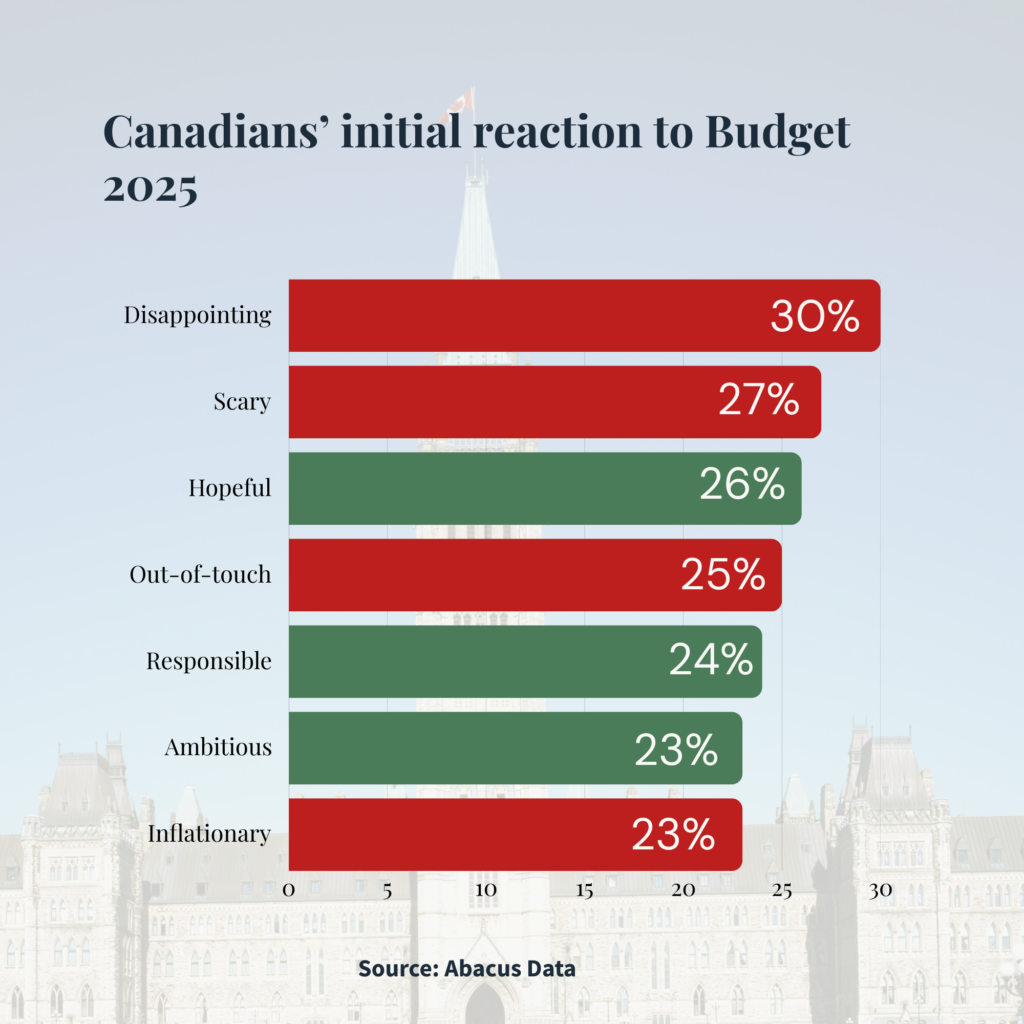
We will have to wait to evaluate outcomes for the economy and Canadians but at the time it was presented, the reception and understanding was mixed: a poll by Abacus Data showed that 52% of Canadians saw it as a step forward while many confused by its mix of spending and restraint.
Two narratives dominated in people’s mind: long-term investment and the government “losing control of the books”.
Some observers also pointed out the budget did more for businesses than individuals. In fact, when asked what the budget was about (unprompted), respondents cited deficit concerns (16%), followed by economic growth and stability (12%).
Even emotionally, the reception was mixed.
The business lens
Less businesses expect cost-related pressure in next three months
Statistics Canada Canadian Survey on Business Conditions in the first quarter of 2026 found that while 59.2% of businesses still expect cost-related obstacles over the next three months, this proportion is down from 61.2% in Q4 2025. These costs include:
- Inflation
- Cost of inputs
- Interest rates and debt costs
- Cost of insurance
- Cost of real estate
- Leasing or property taxes
- Transportation costs.
Inflation is the most commonly expected obstacle (40.8% of businesses).

When it comes to tariff-related costs, 34.1% of businesses are likely to pass increases onto their customers over the next 12 months, while 36.5% do not expect to do so.
Business optimism improves
Nearly three-quarters (73.1%) of businesses are optimistic about their outlook over the next 12 months, up from 66.3% in Q4 and 66.7% in Q3.
Nearly half of businesses expect stable wages
Over the next 12 months, 45.9% of businesses expect wages to be stable, while 41.8% expect an increase.
Who will get the pay increases remains to be seen. But it is noteworthy to point out that 60% of senior management positions are occupied by men in Q1 2026, likely with higher wages and salaries, meaning that a percentage increase would translate into a greater additional dollar amount.
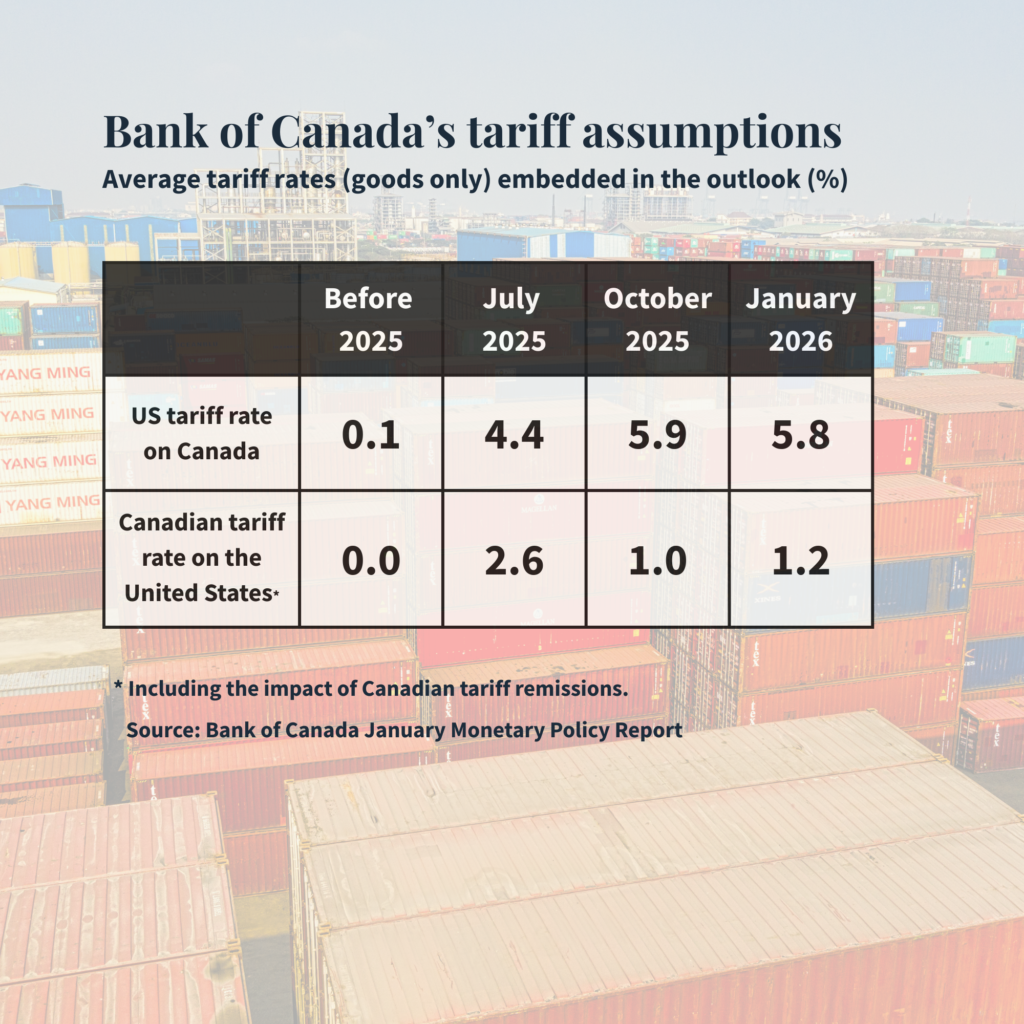
Overall, Canada is still Canada and the economy averted the worst despite a slowdown. In particular, most of Canada’s exports to the U.S. are still protected from additional tariffs as most are compliant with the Canada-United States-Mexico Agreement. CUSMA is up for review this year, a major risk to Canada’s economic outlook.
Carney also wins the popularity contest against the Conservative leader, Pierre Poilievre, based on the most recent polls from Angus Reid showing that 64% of Canadians believe Carney does a good job handling the U.S.-Canada relationship.
Should he call elections – which has been increasingly talked about as a strategy to gain a majority – 45% of Canadians say they would vote for the Liberal Party. This is a 13-point lead over the opposition leader, up from 10 points a month ago.