
If you lead public affairs or communications in government and believe governments don’t sell anything and therefore don’t do marketing, think again.
Canada is on a mission to rebuild in a way that reduces its reliance on the U.S., militarily, digitally, and economically. Governments are seeking to attract foreign investment, build public-private partnerships, convince businesses and individuals to adopt programs, ensure social acceptability of policies, and improve perceptions of public sector careers. On the talent front, an article from The Globe and Mail on staffing the Major Projects Office captured the challenge:
Canadian companies have not historically valued government experience when promoting.
This means that, across multiple fronts, governments—starting at the federal level—must strengthen trust both domestically and internationally.
With only 28.4% of Canadians expressing confidence in the federal government in Q4 2024, the task requires leveraging every available lever. It’s a good moment to revisit what public relations entails, and why its boundaries with marketing are increasingly blurred.
Blurring lines between public relations and marketing
One of the key takeaways from pursuing accreditation in public relations is the breadth of the discipline, often underestimated not only by business units, but even within PR and marketing teams.
The toolbox is extensive and requires systems thinking. Once you adopt that lens, it becomes clear why the lines between PR and marketing are blurring, and why public affairs also requires a systems approach.
Marketing is traditionally defined as selling products and services, while public relations builds mutually beneficial relationships. In practice, both aim to influence behavior: not only buying products and services, but also buying ideas. In fact, advertising and publicity can be translated as propaganda in Spanish (persuasive messaging in the political or ideological context).
A study on the conceptual meanings of propaganda and advertising in Sweden in the 1930s also finds that “propaganda was a key concept of communication and was used in manifold ways for selling goods and disseminating ideas.” Because of that common need to influence, public relations and marketing have always been connected, with marketing selling an experience: some car advertisements barely talk about the car. And this is not new. The evolution of channels has also contributed to thinning the lines between PR and marketing. This is why you can see today a prime minister with a PhD from Oxford, credentials from Harvard and past experience at Goldman Sachs wearing hockey jerseys on social media or hugging Bonhomme, the mascot of Quebec’s Winter Carnival, making for a perfect social media moment.
While marketing and PR are different, they work in the same ecosystem: so thinking that governments do not do marketing as a public affairs professional working for the government will led you to provide siloed subpar advice.
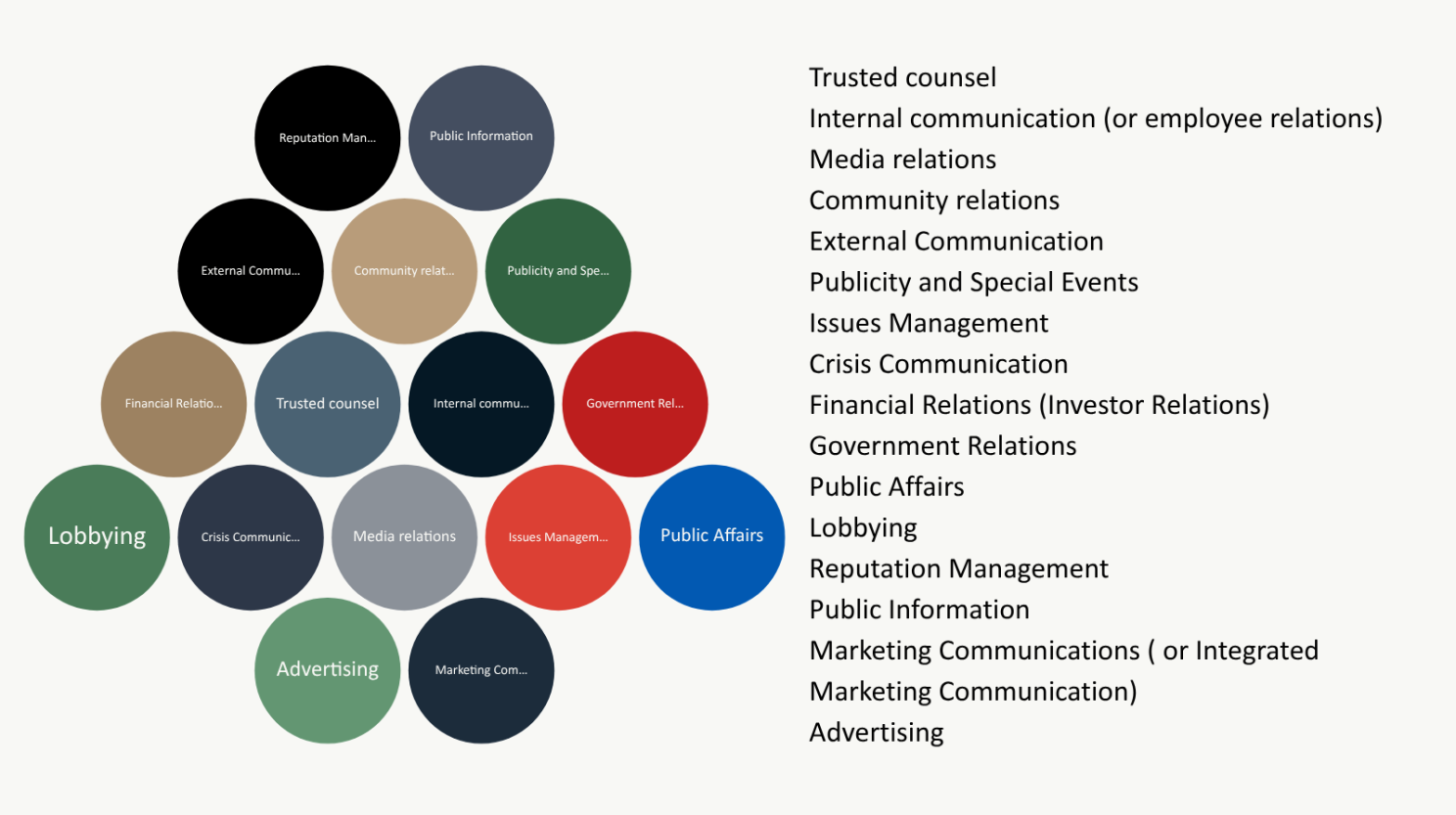
Here are key functions and disciplines of public relations based (Public Relations Society of America):
$78.2 million
In fiscal year 2024-2025, the Canadian government spent $78.2 million on advertising, involving 46 institutions and 1 Agency of Record (AOR), including $64.2 million in media placements.
The November 2025 budget increased the cap by $25 million for 2025–26, supporting campaigns like Choose Canada amid patriotic messaging shifts.
Here are ads you can currently see on Toronto’s billboards:

South of the border, The White House App launched in March 2026, accessible through Google Play and App Store and pitched as “Real-time updates, live events, and direct access to the Presidency”. Back in 2020, President Trump, during his first term, even had his name printed on pandemic relief checks.
When countries compete internationally, they also need to position themselves domestically. This requires an integrated approach: policies, speeches, reports, and data matter. So does how the message travels across the broader ecosystem.
Let’s look at a central issue for Canada’s economic outlook: the upcoming review of the trilateral agreement with the U.S. and Mexico.
CUSMA, USMCA or T-MEC? Same deal, different narratives
When the North American Free Trade Agreement (NAFTA) was renegotiated, it became CUSMA (Canada-United States-Mexico Agreement) in Canada. The order of the countries signals a political priority: Canada first.
In the U.S., the same agreement became USMCA (United States–Mexico–Canada Agreement).
This is not a translation issue. It is a deliberate branding choice.
In Mexico, the agreement is T-MEC (Tratado entre México, Estados Unidos y Canadá), placing Mexico first.

Naming is not neutral.
The order of words, the acronym, and the framing all send signals.
For example, a “support program” may be perceived as a giveaway, while a “lending program” suggests repayment and taxpayer money recovery. If a government simultaneously “supports” large corporations while “lending” to small businesses, the perception risk is that money flows more easily to the biggest players.
Having covered economic policy for 20 years, the patterns are familiar: messaging, including naming, can make or break perception and memorability.
A strong name (and acronym) makes a program easier to quote, repeat, and brief.
TIPS for naming government programs
Try this approach: [public benefit] + [action word] + [simple acronym]
- Benefit first: Lead with outcomes: “Access,” “Safety,” “Care,” “Action.”
- Backronym: Start with the acronym, then build around it.
- Action-oriented: Use verbs like “Build,” “Launch,” “Connect.”
- Plain language: Avoid jargon.
- Pronounceable: Reduce friction.
- Short: Attention is scarce.
- Distinctive: Avoid blending into existing acronyms.
- Bilingual: Find elements that are common to both French and English in Canada. This is part of the Government of Canada’s own Federal Identity Program Model, which actually highlights the need for a systems approach.
All rights reserved: Y perspective.