
The mobilization of capital through sovereign green bonds is part of Canada’s financing strategy to achieve national climate objectives. But convincing investors to accept a lower yield when buying green bonds – the so-called “greenium” – in exchange for a sustainability impact is getting harder.
When the government tabled the 2025 Budget, the Bank of Canada released its summary of Debt Management Strategy Consultations conducted in September and October to seek views from investors and other market participants in preparation of the FY2026-27 domestic debt program.
The summary noted in its very last paragraph, referring to investors incorporating environmental, social and governance factors in their decisions:
Those investors are less inclined than in the past to pay a deep ‘greenium’ at issuance.
As for traditional investors, they are reluctant to pay any premium at all:
Similarly, real money investors with no dedicated green investment mandate are reluctant to pay a premium to buy those securities.
Declining global green bond issuance
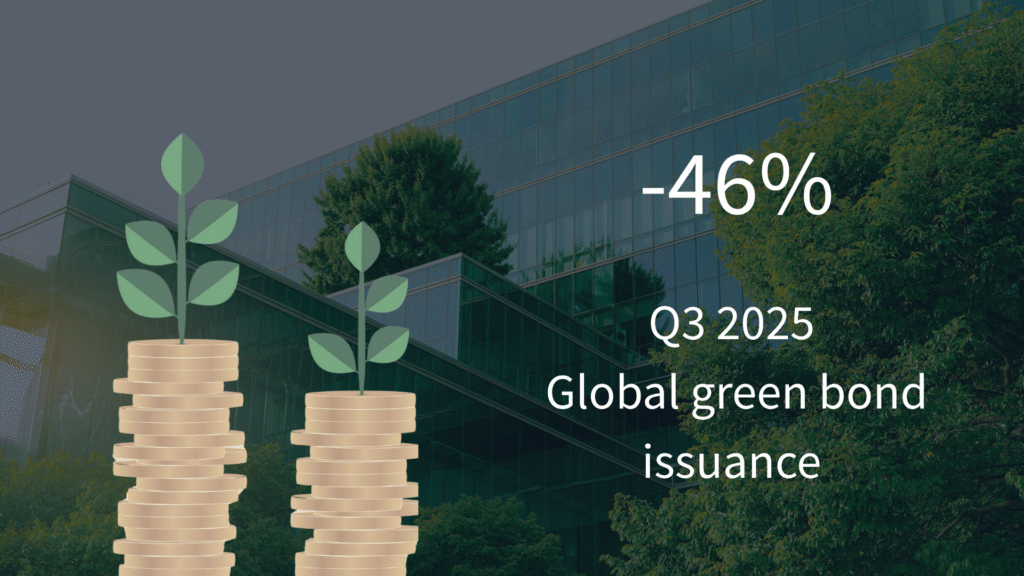
This greenium fatigue is happening against the backdrop of declining green bond issuance globally: Sustainable Fitch estimates that decline at 46% in the third quarter from the second quarter, which includes both corporate and sovereign issuers.
It’s not that demand isn’t there. In fact, the Budget pointed out the “strong demand from green and socially responsible investors” at its $2.5 billion auction in October, citing both Canadian and international investors. It’s that demand is there at market price.
For now, the government is planning to expand its Sustainable Bond Framework, which would allow to issue both green and transition bonds “to finance government spending that helps industrial and agricultural sectors get cleaner and more competitive.” In doing so, it will align with Canadian Sustainable Investment Guidelines expected to be finalized by the end of 2026.
Transition bonds are used to help companies in carbon-intensive sectors (like industry and agriculture) move toward cleaner operations and net-zero emissions, whereas green bonds finance projects that are already green across nine categories of activity:
- Clean Transportation
- Living Natural Resources and Land Use
- Energy Efficiency
- Terrestrial & Aquatic Biodiversity
- Clean Energy (including the deployment of nuclear energy)
- Climate Change Adaptation
- Sustainable Water and Wastewater Management
- Circular Economy Adapted Products, Production, Technologies, and Processes
- Pollution Prevention and Control.

The government is planning to issue $4 billion green bonds in FY2025-26, $2.5 billion of which were already issues, and $4 billion the following year.
Rising sovereign debt issuance
While the amount of green bonds remains stable over the two years, conventional bond issuance is projected to grow, competing for attention in international markets as other developed countries are also seeing their debt increase.
Gross bond issuance is projected to rise to $316 billion in FY2025-26 from $241 billion last year, before coming back down to $298 billion in FY2026-27.
In Canada, the total market debt stock is projected to reach $1.8 trillion by the end of fiscal year 2026–27 from $1.6 trillion, and the government is proposing to raise the limit on the maximum amount it can borrow by $415 billion through March 2030 to $2,541 billion, the largest single increase since the pandemic response.


