
Canada’s Infrastructure Plans
The investment virtuous cycle
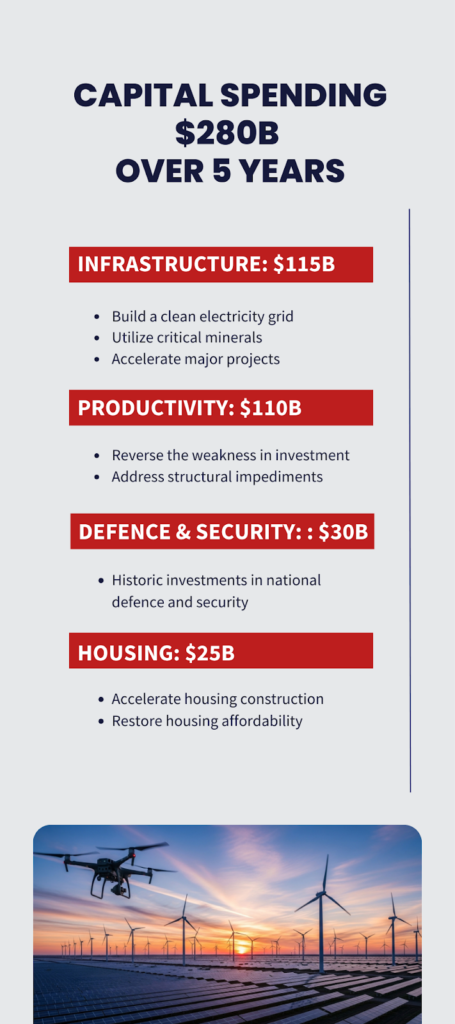
Canada has ambitious plans to rebuild its defense, housing, and energy infrastructures while strengthening its sovereignty, as reflected in the 2025 Canada Strong Budget. The government aims to create a “virtuous cycle of investment and economic growth”:
Over the next five years, direct public capital investments of CAD$280 billion would catalyze CAD$500 billion in additional private sector investments, resulting in GDP growth that is 3.5% higher than would have otherwise occurred.
The government expects that shifting spending toward investments that grow the economy, reducing operational public spending, and catalyzing private-sector investment will enable $1 trillion in total investment over the next five years. To facilitate this, a Major Project Office was created to streamline and accelerate decision-making for ‘nation building’ projects.
Canada has ambitious plans to rebuild its defense, housing, and energy infrastructures while strengthening its sovereignty, as reflected in the 2025 Canada Strong Budget. The government aims to create a “virtuous cycle of investment and economic growth”: Over the next five years, direct public capital investments of CAD$280 billion would catalyze CAD$500 billion in additional private sector investments, resulting in GDP growth that is 3.5% higher than would have otherwise occurred.
The government expects that shifting spending toward investments that grow the economy, reducing operational public spending, and catalyzing private-sector investment will enable $1 trillion in total investment over the next five years. To facilitate this, a Major Project Office was created to streamline and accelerate decision-making for ‘nation building’ projects.
Indigenous Consultation: A Key Consideration
Investors should keep in mind that a key element of the process—also a legal requirement—includes the duty to consult with Indigenous groups, although what actual consultation looks like can differ to different parties.
The University of Calgary School of Public Policy notes: “Canadian courts have repeatedly ruled that the Crown has a duty to consult with Indigenous Peoples when approving and shaping resource development projects that are located on their land or could infringe on their rights. But the duty to consult means different things to Indigenous groups, government, and industry.”
The Canadian government also needs to improve its relationships with some Indigenous groups. The latest news is yet another illustration of the misalignment when it comes to consultation. In late November, the federal government and the Province of Alberta signed a Memorandum of Understanding opening a path to a pipeline to British Columbia’s coast. Coastal First Nations have raised concerns about the project. The Globe and Mail even reported that Indigenous advisors to the government’s own MPO were not told about the agreement, illustrating the challenges to such infrastructure projects. The MOU, which agreed to suspend the proposed implementation of the Oil and Gas Emissions Cap, led to the resignation of a cabinet member, Steven Guilbeault, a long-time environmentalist who previously served as Minister of Environment and Climate Change in the Trudeau government.
Current Investment Levels
To understand the scale of the financing gap, it is instructive to examine current infrastructure investment levels. According to Statistics Canada, total capital spending by businesses and governments in 2024, including construction of structures (airports, roads, etc.), purchases of equipment (locomotives, turbines, etc.), and improvements to existing facilities, reached CAD$136.5 billion. This represents the combined public and private sector investment in productive assets with multi-year utility.
Within this total, environmental and clean technology investment represented CAD$4.7 billion in 2024, or 3.4% of total infrastructure investment.
Debt Context
The government’s ambitions translate into higher borrowing needs, though this is not uniquely a Canadian issue. According to Fitch Ratings, developed market general government debt is likely to exceed USD71 trillion (105% of GDP) by end 2025, up from USD28 trillion in 2007 (68% of GDP).
The Canadian government projects domestic gross bond issuance to increase to CAD$316 billion in the current fiscal year from CAD$241 billion in FY2024-25.
However, BlackRock notes in its 2026 Global Outlook that Canada’s fiscal position is stronger than the U.S., while its growth prospects are softer, which should anchor long-term yields. Although the 2025 budget represents a risk to this outlook, BlackRock favors Canadian long-term government bonds over U.S. Treasuries.
Whether through government financing or nation building projects requiring private investment, Canada offers opportunities, but not without challenges for sustainable investment.
What Makes Canada Attractive to Investors?
Expected trends in asset management are a positive for Canada, at least on the surface. PwC estimates that global assets under management will reach USD$200.4 trillion by 2030, 54% of which will be in North America, amounting to approximately USD$108 trillion. This should be good news for Canada.
The Morningstar Voice of the Asset Owner Survey 2025 Quantitative Analysis also shows that four in 10 asset owners are reducing or plan to reduce allocations to U.S. assets, partly due to political risks.
Prime Minister Mark Carney has, in fact, cited the “rule of law” as one of the advantages of investing in Canada.
Political Stability as a Selling Point
In light of the greater instability of U.S. politics, Canada’s reputation for offering stable institutions could prove its worth. Indeed, according to the Natixis Global 2026 Institutional Outlook Survey, geopolitics now tops the list of economic threats among institutional asset managers: 73% globally believe political dysfunction is a growing threat to market stability. A tech bubble (43%), a recession (33%), and a government crisis (33%) are also top of mind.
The survey found that 63% believe the politicization of U.S. institutions will weaken the investment case for U.S. assets.
Interest in Alternative Assets
In terms of asset class, 65% believe that a portfolio of 60% stocks, 20% bonds, and 20% alternatives will outperform the traditional 60:40 stock and bond portfolio.
This popularity of alternatives could prove beneficial for Canada, not only as it seeks to rebuild its infrastructure through “nation building projects,” but as a resource-rich G7 country: According to the Natixis survey, 63% of institutional asset managers see rare earth minerals as the new energy security. As it turns out, Canada holds some of the largest known reserves and resources of rare earth metals globally.
Infrastructure Investment Trends
Natixis survey shows that within alternatives, private investments dominate, led by private equity (31% of respondents globally), private credit (17%), real estate (16%), and infrastructure (14%). In North America, the proportions are 33%, 20%, 11%, and 15%, respectively.
The survey notes that the infrastructure sector “is at the nexus of three global megatrends that will shape the opportunity,” with supply chain resilience and AI being two of them. For instance, BlackRock targets “middle-market” Canadian firms that need capital to digitize or consolidate.
“In the key sectors that are driving the biggest growth, be it energy, digital infrastructure, both Canada and the U.S. should play a really big role going forward,” Brandon Freiman, the head of North American Infrastructure for U.S. private-equity giant KKR, said in an interview with The Globe and Mail.
Canada is also on the Australian radar, with fund manager IFM Investors, one of the largest infrastructure investors in the world, recently announcing its expansion into Canada, where it has CAD$14.4 billion in funds under management.
Still, the Natixis survey indicates the strongest intent to invest in infrastructure is in Latin America, and the lowest in North America.
Critical Minerals as a Strategic Asset
The strategic importance of Canada’s critical minerals position was underscored in December when the Canadian government approved the merger between Teck Resources Ltd. and Britain’s Anglo American PLC. Several regulatory approvals are still needed in various jurisdictions.
The transaction positions Canada as a key player in the global energy transition supply chain. For infrastructure and private equity investors, this signals potential for further capital deployment in the critical minerals sector.
The Sustainable Investment Picture: It’s Complicated
Global Energy Transition Investments
In addition to AI and supply chain infrastructure, the Natixis survey shows that the third infrastructure-related opportunity stems from energy transition.
There is good news about global energy transition. According to the Climate Policy Initiative (CPI) and the International Renewable Energy Agency, global investments in energy transition technologies reached a record high of USD$2.4 trillion in 2024, a 20% increase from 2022/2023, led by mature technologies: renewable energy, energy efficiency, grids, and electrified transport. While investments in newer technologies slowed, battery storage recorded robust growth. North America and Oceania represent 15% of these investments, led by the U.S., Australia, and Canada.
Canada is the second-largest producer of hydroelectricity in the world, and building a clean electricity grid is part of the government’s capital spending priorities outlined in the budget. The country clearly has opportunities to offer when it comes to evolving to the next generation of energy.
In fact, Canada’s clean energy and waste management is one of the areas where Swedish fund manager EQT’s infrastructure team is reported to have a “continued very high interest,” along with digital and artificial intelligence infrastructure.
Challenges for Sustainable Finance
But challenges remain for sustainable investment, aside from the fact that Canada ranks among the top global producers of oil.
Asset managers surveyed by Natixis mostly see more opportunities in Europe, Asia, and Latin America when it comes to energy transition. Appetite for green bonds is also the lowest in North America, with 10% of respondents planning to increase allocation, compared to 48% in Latin America and 31% globally.
To be sure, institutional investors continue to integrate environmental, social, and governance (ESG) factors for both risk and return.
The Responsible Investment Association 2025 Canadian Responsible Investment Trends Report finds that 96% of Canada’s institutional asset owners and managers integrate ESG factors, representing 87% of assets under management.
Yet the Natixis report shows that ESG and sustainable investment intent is strongest outside of North America, with only 19% of respondents planning to do so, compared with 77% in Latin America.
Declining Sustainable Debt Issuance
As Sustainable Fitch noted in its November US-Canada Sustainable Finance Snapshot, “The North American sustainable finance market has had a challenging year, with labeled debt issuances falling significantly.” Fitch cited policy changes and uncertainty deprioritizing environmental and social initiatives.
Issuance was down 42% over the first nine months of 2025 from the same period a year earlier. Even for green bonds, the foundation of North America’s sustainable debt market, issuance decreased.
“We believe that this may reflect heightened caution and delay toward financing green projects,” the report said, amid heightened scrutiny.
In Canada, the decline was approximately 56% to USD$8.7 billion. According to Sustainable Fitch, green bonds, which account for over 80% of Canada’s labeled debt market by value, fell 47%. There has been no other labeled issuance across non-green labels, except for a small EUR3 million by the National Bank of Canada.
The rating agency underlined the concentrated nature of the Canadian debt landscape relative to the U.S., with financial institutions and Canada’s pension funds dominating the market.
The Bank of Canada itself took notice of greenium fatigue when it comes to government bonds.
Greenium Fatigue
In its summary of Debt Management Strategy Consultations conducted in September and October 2025 to seek views from investors and other market participants, the Bank of Canada noted that investors incorporating ESG factors in their decisions “are less inclined than in the past to pay a deep ‘greenium’ at issuance.”
“Similarly, real money investors with no dedicated green investment mandate are reluctant to pay a premium to buy those securities,” the BoC’s summary added.
Pension Funds
Pension funds’ long-term focus could help investments in Canada. A report by the CPI on State of OECD Pension Funds’ Climate Transition shows that pension funds are making progress on climate targets and implementation.
That being said, “significant gaps” remain, notably for climate investment targets. The report also stressed that OECD countries with clear regulatory guidance for pension funds “set and implement the most targets.” The Netherlands, Denmark, and the UK are among them.
Canada? It’s better than the U.S. But then again, the U.S. is at the bottom of the list when it comes to mandatory climate risk inclusion.
Canada has yet to deliver its green and transition taxonomy expected to be finalized by the end of 2026. The government is also removing greenwashing claims requirements from the Competition Act and the ability for third parties to bring cases directly to the Competition Tribunal for greenwashing complaints.
And when it comes to asset owners influencing asset managers to drive climate impact, the CPI report noted: “European funds consistently outperform peers on stewardship policies and disclosure, while many North American funds lag, often due to legal or political constraints on ESG integration.”