The Bank of Canada had put the ball in the camp of the government when it said that the structural nature of economic damage caused by trade tensions “limits the role that monetary policy can play”.
November 4 was the fiscal policy camp’s response.
Canada Prime Minister Mark Carney’s first budget has a deficit of $78.3 billion for fiscal year 2025-26, much higher than the $42.2 billion estimate of the 2024 Fall Economic Statement (FES), but within the range of experts’ expectations in terms of amount. It’s also more than double the size of the previous year’s $36.3 billion deficit.
In its 493-page document, the finance ministry describes its approach as follows:
The government’s new approach for a strong Canada, focused on driving high impact investments while reinforcing fiscal discipline by reducing day-to-day operating spending, will help ensure Canada maintains its fiscal advantage going forward.
Budget overview
The bottom line: growth forecasts were revised down from the 2024 FES while deficit and debt projections increased.
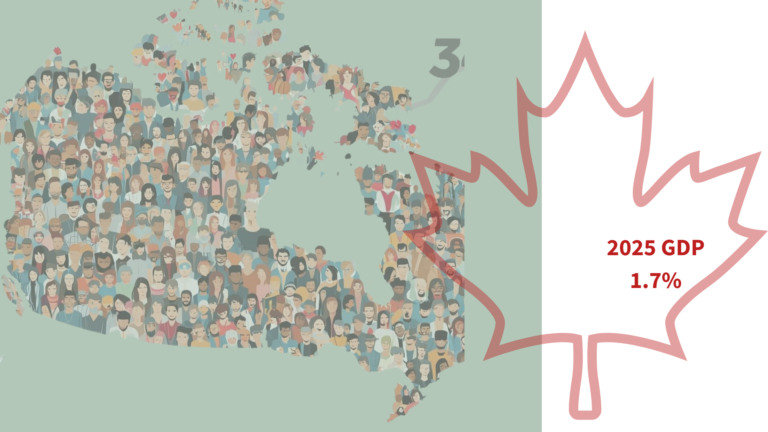
In Canada, the budget’s underlying economic assumptions are derived from the private-sector consensus, which puts Canada’s real GDP at 1.1% this year and 1.2% in 2026, lower than what they were in the 2024 FES. Forecasters expect the Bank of Canada to keep its policy rate at the current 2.25% through 2026.
The growth forecasts are close to the central bank’s GDP projections of 1.2% in 2025 and 1.1% in 2026.

The government narrative: it’s not how much, it’s why
The government is shifting the focus from how much it borrows to “why” it borrows, justifying current deficits as necessary “generational investments”.
The budget is presented as the “roadmap to spend less so we can invest more”.
Bond Issuance
- The gross annual bond issuance is projected at $316 billion in 2025-26, up $75 billion from FY2024-25, before coming back down to $589 billion in FY2026-27.
- The annual issuance limit for Canada Mortgage Bonds (CMB) will increase to $80 billion from $60 billion starting in 2026, with the increase applying exclusively to multi-unit housing. On that topic, you can read a recent analysis from the Parliamentary Budget Officer. “The government will maintain the current pace of its purchases of CMBs, up to $30 billion annually, to allow the private market full access to the additional issuance.”
- The government will explore developing a Sustainable Bond Framework to allow for the issuance of green and transition bonds, aligned with a Canadian taxonomy (sustainable investment guidelines).
- Separately, the BoC noted in the Fall 2025 Debt Management Strategy Consultations Summary that investors in the GoC’s green bond issuance program who consider environmental, social and governance factors in their investment decisions are less inclined than in the past to pay a deep “greenium” at issuance.
- Borrowing Authority: To support growing investments, Budget 2025 proposes to amend the Borrowing Authority Act to increase the maximum amount that can be borrowed from 2,126 billion to 2,541 billion.
Also in reference to the GoC’s green bonds, the central bank said:
Real money investors with no dedicated green investment mandate are reluctant to pay a premium to buy those securities.
Speaking of green.
Climate competitiveness strategy
- The Oil and Gas Emissions Cap would no longer be required if certain conditions are met
- Industrial carbon pricing is a central pillar of the Climate Competitiveness Strategy
- The government will develop a multi-decade industrial carbon price trajectory that targets net-zero by 2050.
Capital investments: $280b over five years
- Infrastructure: $115 billion
- Productivity & Competitiveness: $110 billion
- Defence & Security: $30 billion
- Housing: $25 billion
Public sector job cuts
As part of the “spending less to invest more” approach, the government aims to reduce the size of the public sector:
- A Comprehensive Expenditure Review (CER) aims to reduce full-time equivalent positions by 16,000
- The CER contributes to a larger anticipated decline in the public service population, which is expected to decrease by about 40,000 positions, or 10%, from its peak of almost 368,000 in 2023-24 to roughly 330,000 by the end of 2028-29.
Introducing a new stablecoin legislation
- The legislation will specifically regulate the issuance of fiat-backed stablecoins by non-prudentially regulated issuers in Canada
- Issuers would have to maintain asset reserves, redemption policies, and security safeguards.
- Bank of Canada would oversee legislation.
Some marketing money to diversify markets away from the U.S.
Sources detail several programs and initiatives aimed at diversifying Canada’s exports, many of which involve marketing and trade support.
Trade Diversification Strategy
- CanExport Program Enhancement: $68.5 million over four years (starting in 2026-27)
- AgriMarketing Program: Funding of $75 million over five years (starting in 2026-27)
- New Strategic Exports Office: Being established at Global Affairs Canada to curate a pipeline of international business opportunities and build sophisticated, proactive roadmaps for Canadian senior-level engagement to open doors and remove roadblocks for Canadian companies
- International Business Connections: $8 million over four years (starting 2026-27) to Global Affairs Canada to deepen trade relations with European partners.
- Trade Finance Envelope: Export Development Canada (EDC) will launch a $2 billion concessional trade finance envelope to encourage international partners, particularly in the Indo-Pacific region, to buy Canadian goods in key sectors. EDC also intends to increase its total business facilitated by $25 billion by 2030 to expand exports in strategic sectors.
- Trade Diversification Corridors Fund ($5.0 billion over seven years)
- The ultimate objective of these diversified export efforts is to double non-U.S. exports over the next decade, generating $300 billion more in trade
What’s next?
A vote on the budget is a confidence vote in Canada. This means that either the budget is voted and then it becomes an execution issue. Or the minority government fails to gain the needed votes and an election would be called….again.